
Shabari's Berries
An old tribal woman waits her whole life for Rama and offers him berries she has tasted to be sure they are sweet, and Rama accepts them with love.
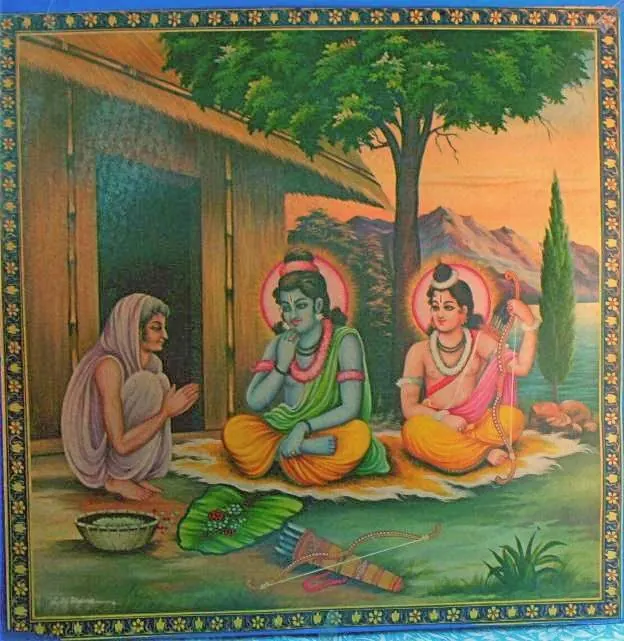
Long ago, a young girl named Shabari was born into a tribal family of hunters. She had a gentle heart and could not bear the killing of animals. Tradition says that on the eve of her wedding, when she saw many animals brought for the feast to be sacrificed, she was so saddened that she ran away into the forest in the night.
She wandered until she reached the ashram of the sage Matanga near Lake Pampa. The sage's disciples were unsure about letting a young tribal woman stay, but Matanga saw her pure devotion. He allowed her to live near the ashram and serve. Every morning, before anyone woke, Shabari swept the paths the sages walked on, removed thorns and stones, and brought firewood and water, without asking for anything.
The years passed, and Matanga grew old. Before leaving his body, he blessed Shabari. 'My daughter,' he said, 'one day Lord Rama himself will come to this ashram. Wait for him. When you see him, your life will be fulfilled.' From that day, Shabari had only one wish: to see Rama.
She waited and waited. Every morning she swept the path, decorated it with flowers and said, 'Perhaps Rama will come today.' Every day she went into the forest to pick the sweetest berries for him. Because she wanted to give Rama only the best, she tasted each berry. If it was sour, she threw it away. If it was sweet, she kept it in her basket. Every evening, when Rama did not come, she was not disappointed. She simply said, 'Tomorrow, then.' Her hair turned white, her back bent with age, but her faith never wavered.
At last, one day, two young princes in hermit's clothes walked up the path: Rama and Lakshmana, searching for Sita. Shabari recognised Rama at once. Her heart overflowed. Tears ran down her wrinkled face. She fell at his feet, washed them with water and with her tears, and seated the brothers on a mat of leaves.
Then she brought her basket of berries. She did not have anything else. Lakshmana noticed that each berry had been bitten. He looked uncomfortable, thinking they had already been tasted. But Rama took the berries from Shabari's hands and ate them with great joy, praising their sweetness again and again. 'I have never tasted anything so sweet,' he said. For Rama, it was not the berry that was sweet, but the love with which it had been offered.
Shabari, feeling unworthy, said, 'I am a woman of low birth, uneducated, with no knowledge of scriptures or rituals. How can I worship you?' Rama replied that he recognised no difference of birth, caste or status, only the relationship of devotion. He then explained the nine forms of bhakti, the navadha bhakti, which include keeping the company of saints, loving to hear God's stories, serving the teacher, singing God's name and living with a simple, trusting heart. 'You have all of them,' Rama told her.
Shabari told Rama that he should go to the Rishyamuka mountain and make friends with Sugriva, who would help him find Sita. Then, with Rama's permission, she entered the sacred fire and attained liberation, her long wait finally fulfilled.
The story of Shabari is loved by devotees because it shows that God cannot be won by wealth, learning or high birth, but only by love and patience. Her half-eaten berries, offered from a pure heart, were dearer to Rama than any royal feast. Even today, 'Shabari's wait' describes the patient, faithful longing of a devotee for God.
Based on the Valmiki Ramayana (Aranya Kanda) and devotional tradition
