
Krishna Lifts Govardhan
When Indra sends a raging storm to punish Vrindavan, young Krishna lifts Govardhan Hill on his little finger and shelters everyone for seven days.
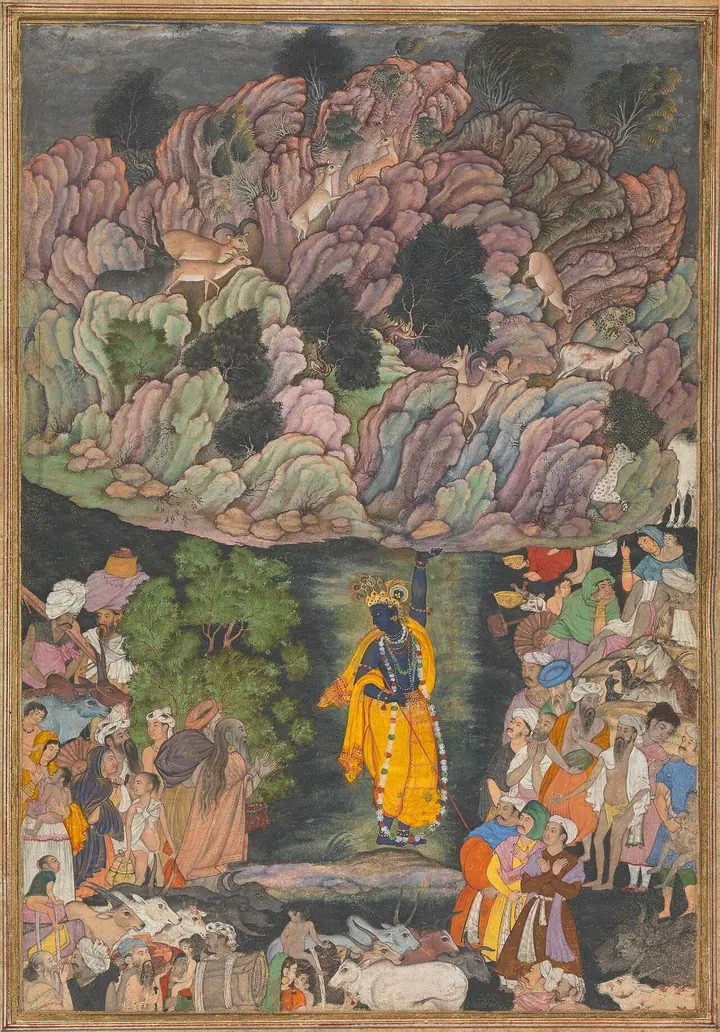
In Vrindavan the cowherds lived simply, caring for their cows on the green pastures along the Yamuna. Every year, at the end of the monsoon, they prepared a great offering to Indra, king of the gods and lord of rain. They believed that Indra sent the rains that made the grass grow and fed their cattle.
One year young Krishna saw the villagers busy cooking mountains of food. He went to his father Nanda and asked, 'Father, for whom are all these preparations?' Nanda explained, 'For Lord Indra, my son. He sends the rain. If we please him, our cows will have grass.' Krishna thought for a moment and said, 'But Father, rain falls because of nature. Our cows graze on Govardhan Hill. The hill gives us grass, water and shelter. Why not honour Govardhan, the cows and the brahmins instead?'
The villagers loved Krishna and trusted his words. They took all the food they had cooked and offered it to Govardhan Hill. They decorated their cows, walked around the hill in procession and fed everyone. Krishna, in a large divine form, appeared on the hill and accepted the offering, saying 'I am Govardhan,' while also standing among the villagers as himself.
But in heaven, Indra was furious. 'These cowherds have forgotten me because of a child,' he roared. In his pride he called the Samvartaka clouds, the clouds of destruction, and ordered them to flood Vrindavan. The sky turned black. Thunder crashed. Rain fell in torrents, and hailstones as big as stones pounded the village. The winds howled. The rivers overflowed. The cows trembled, and the people ran to Krishna, crying, 'Save us, Krishna!'
Krishna smiled calmly. 'Do not be afraid,' he said. He walked to Govardhan Hill, and with the ease of a child picking up a mushroom, he lifted the entire hill with the little finger of his left hand and held it high like an umbrella. 'Come,' he called. 'Bring your cows, your calves and your families. Come under the hill. You will be safe here.'
The people of Vrindavan hurried beneath the hill with their cattle and their belongings. Underneath, it was dry and warm. For seven days and seven nights Indra's storm raged, but not a drop of water touched them. Krishna stood holding the mountain, never tired, never hungry, smiling at his friends. The gopas brought their sticks to help support the hill, and Krishna laughed, letting them believe they were helping.
Indra poured all his power into the storm, but it made no difference. At last his clouds were empty. His pride broke. He understood that the child of Vrindavan was no ordinary boy but the Supreme Lord himself. The storm stopped, the sun came out, and Krishna gently placed the hill back in its place. The villagers came out and embraced him, and the mothers blessed him with tears of joy.
Indra came down from heaven, humbled, with Surabhi, the divine cow. He bowed at Krishna's feet and asked forgiveness. 'I forgot that my power comes from you,' he said. Krishna forgave him kindly and told him to perform his duties without pride. Surabhi bathed Krishna with her milk, and Indra named him Govinda, the protector of cows.
Because of this story, Krishna is called Giridhari, the one who holds the mountain. The day after Diwali is celebrated as Govardhan Puja and Annakut. Devotees make small hills of cow dung or prepare a mountain of many different foods to offer to Krishna. In Gujarat, the Annakut offering in temples is a joyful sight, with hundreds of dishes arranged before the Lord.
Pilgrims still walk the parikrama, the circumambulation of Govardhan Hill, in Braj, about twenty one kilometres long, some doing it barefoot or prostrating the whole way. The story teaches that God protects those who take shelter in him, that nature which nourishes us deserves gratitude, and that pride, even in a god, must eventually bow before love.
Based on the Bhagavata Purana
